Introduction
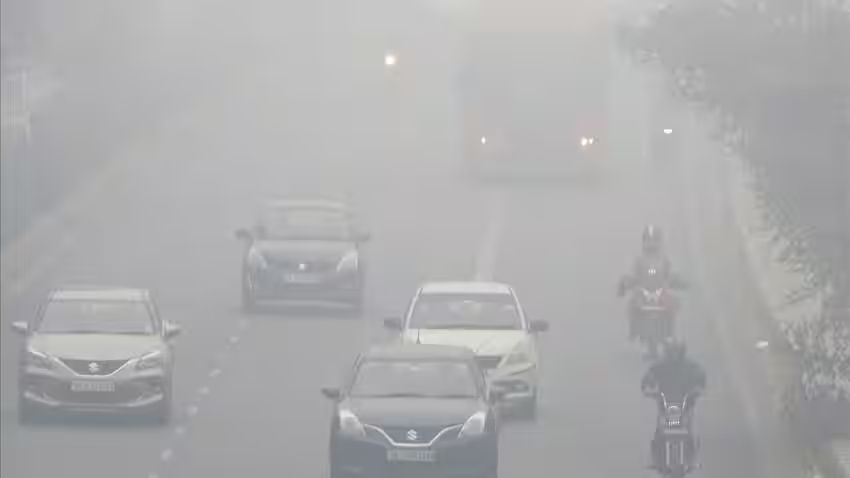
Delhi’s winter pollution story in 2025 is again defined by “Severe” AQI days, dense smog, low visibility,
and emergency rules under GRAP (Graded Response Action Plan). When the air turns toxic, the biggest public question becomes simple:
“Can I drive my car today?”
In the last few weeks, “Delhi car ban” has trended across news, auto media (including coverage formats popular on channels like
Trakin Auto), and everyday WhatsApp forwards—often mixing correct updates with half-truths.
So this blog breaks it down clearly:
- What Delhi’s AQI indicates and why winter makes pollution worse
- How GRAP Stage III/IV works and who activates it
- What’s the actual vehicle restriction: BS6 vs BS4 vs BS3 (and what “entry ban” really means)
- How the No PUC, No Fuel rule works at petrol pumps
- What you should do as a Delhi-NCR vehicle owner so compliance doesn’t become chaos
We’ve included real, valid external news/official links inside the blog so you can verify updates yourself.
1) AQI in Delhi: what the numbers actually mean
AQI (Air Quality Index) is a single number that summarizes pollution levels measured through pollutants like
PM2.5, PM10, NO2, O3, CO, etc. In Delhi’s winter peak, the most damaging component is usually
PM2.5—fine particles that go deep into lungs.
When AQI touches the “Severe” zone, it’s not just “bad air”—it triggers emergency action.
In late December 2025, Delhi recorded a “Severe” AQI and severe visibility disruption was reported across the city.
You can read one such report here:
Times of India — AQI hits severe, flights/trains delayed.
Practical takeaway: AQI isn’t a “weather mood.” In Delhi-NCR, once the city sits in the severe band, policy shifts quickly:
vehicle restrictions, construction curbs, dust control drives, and fuel-station checks can intensify within hours.
2) Why Delhi’s air gets worse every winter
Delhi’s winter pollution is a combination of emissions + weather:
- Vehicle emissions: large traffic volume + congestion = higher idling emissions
- Road dust: re-suspended dust from roads, construction material, broken surfaces
- Regional smoke: stubble/biomass burning and seasonal fire events (varies by year)
- Winter inversion: cold air traps pollutants close to the ground
- Low wind speed & fog: pollutants don’t disperse and visibility drops
That’s why Delhi can have a day where “nothing new happened,” yet AQI spikes because dispersion collapses.
When it stays severe for consecutive days, authorities move toward GRAP’s higher stages.
3) GRAP & CAQM: who triggers restrictions and why
GRAP is Delhi-NCR’s emergency response framework for air pollution. It activates in stages (I to IV) based on air quality levels
and forecasts. A key body in this system is CAQM (Commission for Air Quality Management in NCR and adjoining areas),
which issues orders and directions to implement GRAP actions across Delhi and NCR districts.
4) “Delhi car ban”: what’s banned, what’s allowed
“Delhi car ban” is a simplified phrase. In most GRAP high-stage periods, the restriction is not “all cars”—it’s targeted:
older, higher-emission categories and non-compliant vehicles (and sometimes entry restrictions for outstation vehicles).
In December 2025, reports widely covered a restriction approach where only BS6-compliant vehicles (and cleaner alternatives like CNG/EV)
were allowed entry from outside Delhi during enforcement periods—while older categories faced restrictions.
For a clear explainer-style report, see:
NDTV Auto — Can your car enter Delhi? BS6 vs BS4/BS3 restrictions.
Another detailed update on the “BS3/BS4 ban vs BS6 permitted” framing:
Hindustan Times Auto — Delhi pollution leads to BS3/BS4 restrictions; BS6 permitted.
Practical takeaway: Whenever GRAP escalates, assume rules may change quickly. Check a reliable news update and CAQM/official orders,
especially if you are an NCR commuter entering Delhi daily.
5) BS3 vs BS4 vs BS6: the emission standard breakdown
BS (Bharat Stage) is India’s emission standard system for vehicles. Higher BS generally means stricter limits on pollutants.
- BS3: older standard, generally higher emissions; more likely to be targeted in GRAP restrictions
- BS4: improved over BS3; but still restricted during severe episodes (often BS4 diesel is a frequent target)
- BS6: latest mainstream standard introduced nationally in 2020; typically treated as “allowed” in many restriction windows
But a key nuance that gets missed:
BS6 does not mean “non-polluting”. It means the vehicle meets a stricter emission norm under test and compliance conditions.
Real-world pollution still depends on maintenance, driving conditions, congestion, fuel quality, and enforcement.
Legal and enforcement focus on older categories also evolves through court interventions.
For context on how courts have addressed older-vehicle bans in Delhi-NCR, see:
Autocar India — Supreme Court reinstates ban on BS3 and older vehicles in Delhi-NCR.
6) No PUC, No Fuel: how enforcement works
One of the strongest compliance pushes in Delhi is the “No PUC, No Fuel” approach:
if a vehicle does not have a valid Pollution Under Control (PUC/PUCC) certificate, fuel stations may deny refuelling
during enforcement drives.
This is especially visible during GRAP escalation, when authorities combine:
- border checks for entry restrictions
- ANPR / camera-based identification
- spot challans for missing PUC
- fuel-station enforcement drives
For a recent explainer report around the December 2025 “no PUC, no fuel / no entry” framing, you can reference:
Times of India Auto — No PUC, no fuel, no entry (Dec 2025 update).
Practical takeaway: Even if your vehicle is BS6, a missing/expired PUC can still cause real trouble during high enforcement periods.
7) Are BS6 cars “safe” for pollution? (Reality check)
During severe pollution weeks, people often assume: “If I have BS6, I’m fine.” In enforcement terms, BS6 may be
more likely to be permitted. But from an air-quality perspective:
- BS6 vehicles still emit pollutants (just under stricter limits)
- Congestion and idling can make emissions worse in real-world conditions
- Bad maintenance (dirty filters, engine issues) increases real emissions
- Road dust and non-exhaust emissions (brake/tire wear) still matter
This is why policy also targets non-vehicle sources (construction dust, waste burning) alongside vehicle restrictions.
BS6 is not a “pollution exemption”—it’s a compliance threshold.
8) What Delhi-NCR vehicle owners should do right now
- Confirm your BS category (BS3/BS4/BS6) from your RC/vehicle documents or manufacturer details.
- Keep PUC valid — don't wait for enforcement days. During crackdowns, queues and checks become intense.
- Check GRAP stage daily if you commute from Gurugram/Noida/Ghaziabad/Faridabad into Delhi.
- Avoid border surprises: if your vehicle is below BS6 and registered outside Delhi, assume entry can be restricted during GRAP III/IV.
- Prefer public transport in severe weeks (it reduces exposure + avoids sudden restrictions).
- Save compliance proof: keep PUC receipt and digital documents accessible on phone.
If your long-term plan involves transferring a vehicle, moving it out of Delhi, or correcting RC records, it's smarter to
keep documentation and compliance clean. For example:
Ownership Transfer in DL08 (Wazirpur, Delhi)
and (if moving the vehicle out of Delhi)
NOC in DL09 (Palam, Delhi)
.
For on-ground help with RC corrections, transfers and compliance documentation across Delhi zones,
RTO Consultants in Delhi
can help you get your paperwork in order before the next GRAP escalation catches you off-guard at a border or checkpoint.
Conclusion
Delhi’s winter air pollution in 2025 is not just an environmental headline—it changes daily life.
When AQI turns severe, authorities shift into emergency mode via GRAP, and vehicle rules tighten:
entry restrictions, targeted bans on older categories, and strict enforcement like No PUC, No Fuel.
If you drive in Delhi-NCR regularly, the smart play is simple:
stay document-ready, check GRAP updates, and don’t rely on forwarded messages for policy.
Use official orders and reliable news sources—and keep your compliance clean so you don’t lose time at borders, pumps, or checkpoints.
How Fateh Legacy helps with Delhi vehicle compliance
Pollution enforcement and GRAP weeks often expose paperwork gaps: expired PUC, pending RC updates, missing endorsements,
or transfer/NOC delays. Fateh Legacy supports Delhi vehicle owners with structured, step-by-step assistance for
RTO-linked workflows—so your documentation remains clean when rules tighten.
Need help with Delhi vehicle paperwork during changing rules?
Get guidance for RC-related tasks, transfers, NOC and compliance-ready documentation so your vehicle records stay smooth
even when GRAP restrictions and enforcement drives intensify across Delhi-NCR.
Talk to our Delhi Transport Expert
Frequently Asked Questions
Is there a complete Delhi car ban during high AQI days?
Usually no. Restrictions are typically category-based under GRAP—focused on older, higher-emission vehicles, entry restrictions for certain outstation vehicles, and strict enforcement of compliance like valid PUC.
What does BS6 mean, and why is it often “allowed” during restrictions?
BS6 is a stricter emission standard. During GRAP escalation, rules often target older categories (BS3/BS4). But BS6 is not “zero pollution”—it’s a compliance threshold under stricter norms.
Are BS4 petrol vehicles always banned in Delhi-NCR?
No. Restrictions vary by GRAP stage and by order wording. Often, restrictions focus on BS3 petrol and BS4 diesel during severe stages, while “entry bans” may target outstation vehicles below BS6 in certain enforcement windows. Always check the latest official order.
What is GRAP and who enforces it?
GRAP is the emergency pollution response plan for Delhi-NCR. CAQM issues directions and multiple agencies (traffic police, transport, local bodies) enforce actions like vehicle restrictions, construction curbs, and dust control.
What is “No PUC, No Fuel” in Delhi?
It means vehicles without a valid PUC/PUCC certificate may be denied refuelling during enforcement drives. It’s used to push compliance and reduce high-emission vehicles on roads during severe pollution periods.
How can I quickly check my vehicle’s BS norm (BS3/BS4/BS6)?
Check your RC details, manufacturer documentation, or official records tied to your vehicle model/year. If you’re uncertain, confirm with your dealership or manufacturer support.
If my car is BS6, do I still need a PUC certificate?
Yes. Even BS6 vehicles may be required to maintain valid PUC/PUCC as per rules and enforcement drives. Don’t assume BS6 automatically protects you from checks.
Do these rules apply only in Delhi or across NCR?
Many GRAP actions apply across Delhi-NCR and adjoining districts because pollution is regional. CAQM directions often cover multiple NCR districts, not just Delhi.
Will vehicle restrictions alone fix Delhi’s pollution?
Vehicle rules help, but Delhi’s pollution also involves road dust, construction, waste burning, and weather conditions like inversion. Sustainable improvement needs multi-source control, not only car bans.
What’s the safest way to keep up with changing rules?
Use official CAQM/GRAP orders and reliable news updates. Avoid relying on forwarded social posts. Keep your PUC updated and documents ready if you commute into Delhi frequently.