Introduction
Every winter, Delhi's air quality drops sharply, forcing the
Commission for Air Quality Management (CAQM) to activate the
Graded Response Action Plan (GRAP). For vehicle owners in
Delhi, New Delhi, East Delhi, West Delhi, Dwarka, Rohini, Mayur Vihar, Lajpat Nagar, Karol Bagh,
Saket, Vasant Kunj and all Delhi RTO zones (DL01–DL13), understanding GRAP rules is now essential.
According to the official CAQM GRAP Framework, restrictions are applied
dynamically based on daily air quality levels across Delhi NCR.
This clear 2025 guide explains:
- What GRAP is and why it was created for Delhi NCR
- All four GRAP stages (from Poor to Severe+)
- Vehicle restrictions, PUCC rules and challans under each stage
- Impact on diesel/petrol vehicles, commercial fleets and daily commuters
- How to stay compliant as a Delhi vehicle owner
- How Fateh Legacy helps with GRAP-related RTO and documentation work
1. What is GRAP in Delhi?
GRAP (Graded Response Action Plan) is an emergency pollution-control framework
enforced by CAQM based on Delhi's daily Air Quality Index (AQI) levels.
Whenever pollution reaches danger levels, GRAP brings in pre-decided restrictions.
GRAP directly impacts:
- Daily vehicle usage and traffic movement inside Delhi
- PUCC (Pollution Under Control Certificate) requirements and checking
- Entry of commercial and diesel vehicles into Delhi from other states
- Movement of BS-III petrol and BS-IV diesel vehicles
- Construction activity, industrial operations and overall traffic flow
Delhi's GRAP rules are much stricter than most other Indian cities due to extremely severe winter smog.
As reported regularly by NDTV Delhi,
AQI levels often cross the "Severe" category in early winter.
2. GRAP Stages 1–4 in Delhi (2025) – Full Breakdown
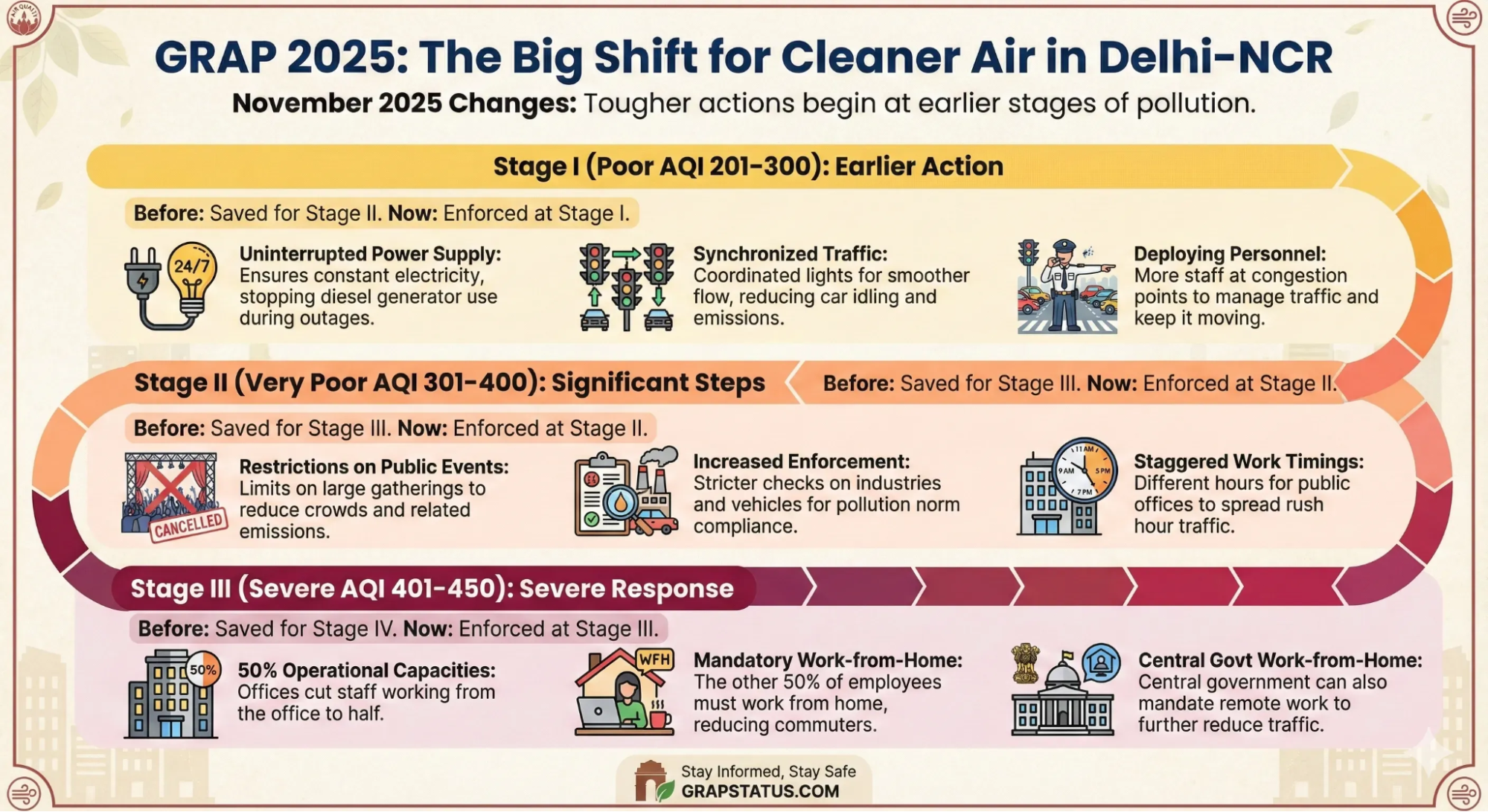
Delhi follows four GRAP stages. Each stage is linked to a specific AQI range and set of actions:
| GRAP Stage |
AQI Range |
Category |
| Stage 1 |
201–300 |
Poor |
| Stage 2 |
301–400 |
Very Poor |
| Stage 3 |
401–450 |
Severe |
| Stage 4 |
450+ |
Severe+ / Emergency |
Daily AQI updates are available on the SAFAR Delhi AQI Dashboard,
which many Delhi residents use to track pollution conditions.
3. GRAP Stage 1 (AQI 201–300): POOR Air Quality
When AQI enters the Stage 1 (Poor) range, Delhi authorities start strict monitoring but do not
impose the heaviest restrictions yet.
Vehicle Rules for Stage 1
- Strict checking of PUCC certificates across all Delhi RTO zones (DL01–DL13).
- Vehicles without valid PUCC face challans under the Motor Vehicles Act.
- PUCC validity can be verified on the official Parivahan PUCC Portal.
- Increased enforcement near Delhi borders such as Ghazipur, Tikri and Singhu.
- Delhi Traffic Police conducts random emission checks on main corridors.
Who Should Be Alert in Stage 1?
- Daily commuters using Ring Road, NH-48, ITO, Dwarka Flyover, Rajouri Garden.
- Commercial vehicle operators entering Delhi from NCR border points.
- Fleet owners whose vehicles regularly move between Delhi, Noida and Gurgaon.
4. GRAP Stage 2 (AQI 301–400): VERY POOR Air Quality
When AQI rises to the Stage 2 (Very Poor) range, restrictions become tougher and authorities
target visibly polluting vehicles and sources more strictly.
Vehicle Restrictions in Stage 2
- No diesel generator sets are allowed, except for emergency services.
- Strict action on polluting commercial vehicles trying to enter Delhi.
- More aggressive PUCC drives at petrol pumps across Delhi.
- Increased fines and challans for smoke-emitting vehicles.
Delhi Areas Where Stage 2 Hits Hard
- Anand Vihar, Jahangirpuri, RK Puram, Punjabi Bagh, Bawana (high-traffic and industrial areas).
- High-construction zones such as Dwarka, Delhi Cantt and Vasant Kunj.
- Corridors with heavy bus and truck movement.
5. GRAP Stage 3 (AQI 401–450): SEVERE Category
At Stage 3 (Severe), Delhi experiences very unhealthy pollution levels.
This is when some of the strictest vehicle-related restrictions start.
Vehicle Restrictions under Stage 3
- Ban on BS-III petrol vehicles inside Delhi.
- Ban on BS-IV diesel vehicles inside Delhi.
- Heavy enforcement and checking across key Delhi RTO and traffic zones, including:
- DL01 – Mall Road
- DL03 – Sheikh Sarai
- DL04 – Janakpuri
- DL06 – Sarai Kale Khan
- DL09 – Palam
- DL10 – Raja Garden
- Construction bans and diversions often lead to higher traffic congestion and more challans.
During Stage 3, the Delhi Pollution Control Committee (DPCC)
issues daily compliance notices and updates for citizens, industries and transporters.
6. GRAP Stage 4 (AQI 450+): SEVERE+ / Emergency Stage
When AQI crosses 450, Delhi enters Stage 4 (Severe+ / Emergency).
These are the most extreme restrictions to protect public health.
Vehicle Restrictions in Stage 4
- Complete ban on most diesel Light Motor Vehicles (LMVs) except for essential/emergency services.
- No entry for non-essential commercial diesel vehicles from Haryana, Uttar Pradesh or Rajasthan into Delhi.
- Very strict checks at:
- Delhi–Gurugram Border
- Delhi–Noida DND / Chilla
- Badarpur Border
- GT Karnal Road and other major entry points
- Truck entry bans except for essential supplies (food, fuel, medicines, etc.).
The Times of India
frequently reports real-time updates whenever Stage 4 is activated.
7. Delhi PUCC Rules Under GRAP (2025 Update)
During GRAP, Delhi tightens PUCC (Pollution Under Control Certificate) regulations for all vehicles.
- PUCC must be valid and verifiable online via the official Parivahan Emission Certificate Portal.
- Petrol pumps may refuse fuel if a vehicle does not have a valid PUCC.
- High-challan zones include Anand Vihar, ITO, Dwarka Mor, Laxmi Nagar and other pollution hotspots.
- PUCC details must exactly match the data on your RC (registration certificate).
- Penalty for invalid PUCC in Delhi can go up to ₹10,000 + possible vehicle seizure.
8. How Delhi Vehicle Owners Can Stay Compliant (Checklist)
Here is a simple GRAP compliance checklist for Delhi vehicle owners in 2025:
1. Maintain a Valid PUCC
- Renew PUCC before expiry at authorised emission centres.
- Cross-check online via the Parivahan Emission Certificate Portal.
2. Avoid Driving Restricted Vehicles
- During Stage 3 and Stage 4, avoid using vehicles banned under GRAP, such as:
- BS-III petrol vehicles (Stage 3 and above).
- BS-IV diesel vehicles (Stage 3 and above).
- Restricted diesel LMVs during Stage 4.
3. Follow Daily Pollution Alerts
- Track real-time AQI levels on:
- SAFAR Delhi AQI Dashboard
- Official CAQM GRAP notifications and Delhi Government updates
4. Keep All RTO Documents Updated
This is especially important if you use key Delhi RTO services such as:
- RC Transfer / Ownership Transfer
- NOC (No Objection Certificate)
- Fitness Certificate renewal for commercial vehicles
- Hypothecation Removal (loan closure)
- Duplicate RC in case of loss or damage
Keeping documents updated makes it easier to handle GRAP checks, online applications and future restrictions.
9. Delhi Areas Most Affected by GRAP Every Year
Some parts of Delhi see very high AQI and strict enforcement almost every winter. As highlighted in an Indian Express report on Delhi’s worst AQI hotspots, areas like Anand Vihar, Wazirpur and Jahangirpuri consistently rank among the most polluted zones during GRAP season.
- Anand Vihar – major transport hub and pollution hotspot.
- Jahangirpuri – heavy traffic and industrial presence.
- RK Puram – busy residential and office region.
- Punjabi Bagh – high traffic volume and construction.
- Bawana – industrial belt in North-West Delhi.
- Dwarka Sector 21–23 – near airport and expressways.
- Saket–Malviya Nagar – dense residential and commercial mix.
- Vasant Kunj – high traffic, construction and commercial activity.

If you regularly drive or operate commercial vehicles in these areas, always track latest GRAP stage
and follow restrictions applicable for that day.
How Fateh Legacy helps with GRAP-related RTO work
GRAP not only affects where and when you can drive, but also how smoothly you can complete
RTO work like RC transfer, NOC, fitness renewal and hypothecation closure. Many Delhi vehicle owners
face issues due to:
- Pending traffic challans linked to pollution and other violations.
- Incorrect or outdated RC details (address, fuel type, owner name).
- Missing or invalid PUCC while applying for RTO services.
- Confusion about bans on BS-III / BS-IV vehicles and their documentation.
This is where Fateh Legacy acts as your trusted Delhi RTO partner.
- Guidance on clearing challans and regularising vehicle documents.
- Support for RC Transfer, NOC, Fitness Certificate, Hypothecation Removal and Duplicate RC.
- Clear checklists so that your paperwork is GRAP-compliant and accepted quickly by RTO offices.
Need help with GRAP, challans or RTO paperwork in Delhi?
Fateh Legacy assists Delhi vehicle owners and transport operators with challan support, RC transfer,
NOC, fitness, hypothecation removal and duplicate RC so you stay compliant even when GRAP stages change.
Talk to our Delhi RTO Expert
Conclusion
GRAP affects vehicle movement, PUCC, challans, NOC, RC transfer and daily mobility in Delhi every winter.
As AQI worsens from Stage 1 (Poor) to Stage 4 (Severe+), rules become stricter for both
private and commercial vehicle owners.
Staying compliant not only keeps your vehicle safe on Delhi roads but also protects you from sudden
restrictions whenever AQI worsens. By:
- Maintaining a valid PUCC,
- Avoiding restricted vehicles during higher GRAP stages,
- Tracking daily AQI and GRAP updates, and
- Keeping all RTO documents updated,
you can significantly reduce the risk of fines, vehicle seizure or delays in important RTO services.
If you need personalised guidance, Fateh Legacy is ready to help you navigate GRAP-linked
vehicle documentation smoothly.
Frequently Asked Questions
What is GRAP in Delhi and who enforces it?
GRAP (Graded Response Action Plan) is an emergency pollution-control framework for Delhi NCR. It is enforced by the Commission for Air Quality Management (CAQM), in coordination with Delhi Government, DPCC and Delhi Traffic Police.
How many GRAP stages are there in Delhi?
There are four GRAP stages in Delhi – Stage 1 (Poor), Stage 2 (Very Poor), Stage 3 (Severe) and Stage 4 (Severe+ / Emergency). Each stage has its own set of restrictions based on AQI levels.
Are BS-III petrol and BS-IV diesel vehicles banned under GRAP?
Under Stage 3 of GRAP, BS-III petrol and BS-IV diesel vehicles are generally prohibited from plying inside Delhi. During Stage 4, restrictions become even stricter, especially for diesel vehicles.
What happens if my vehicle does not have a valid PUCC during GRAP?
Driving without a valid PUCC can lead to a challan of up to ₹10,000 and even possible vehicle seizure in Delhi. Petrol pumps may also refuse fuel to vehicles without valid emission certificates.
How can I check daily GRAP stage and AQI in Delhi?
You can check daily AQI and GRAP-related updates through the SAFAR Delhi AQI Dashboard, official CAQM notices, and Delhi Government or media portals that publish pollution alerts.
Does GRAP affect RC transfer or NOC work for vehicles in Delhi?
Yes. If your vehicle has pending pollution-related challans, invalid PUCC or non-compliant fuel category, it can complicate RC transfer, NOC, fitness renewal and other RTO services during GRAP periods.
Can I drive my diesel car during GRAP Stage 4 in Delhi?
During GRAP Stage 4 (Severe+), most diesel Light Motor Vehicles (LMVs) are banned inside Delhi, except those involved in essential or emergency services. Always check official notifications before driving.
Which areas in Delhi face the strictest GRAP enforcement?
Areas like Anand Vihar, Jahangirpuri, RK Puram, Punjabi Bagh, Bawana, Dwarka, Saket–Malviya Nagar and Vasant Kunj often see strict GRAP enforcement due to high pollution and heavy traffic.
How can Fateh Legacy help me with GRAP-related issues?
Fateh Legacy helps Delhi vehicle owners with challan support, RC transfer, NOC, fitness, hypothecation removal and duplicate RC, ensuring your documents are in order and GRAP-compliant.
Where can I get official GRAP rules for Delhi?
Official GRAP rules and updates are published by CAQM on caqm.nic.in, and also shared through Delhi Government and agencies like DPCC and Delhi Transport Department.